• 12/20/2016 6:07 PM | Deleted user

    By Aubri Hostetter of Excel Equine


    One of the most common struggles I hear from horse owners is that they always have one or two horses that they are trying to put weight on.  When you feel as though you are doing everything right, such as deworming regularly, getting their teeth done, having great quality hay and feed, and consulting your veterinarian to see if there are any underlying issues, it can be easily frustrating to not notice an improvement in your horse’s body condition.  Sometimes horses are simply hard keepers…just like some people!  One practice that I have seen people have success with is supplementing with rice bran.  There are many advantages to engaging in this feeding practice and a few precautions that need to be taken into consideration as well. 

    First, rice bran is the brown layer left from when the rice seed is harvested.  So yes, it is a by-product of rice milling…which just goes to show you that by-products are not bad!  There are many by-products that make great feed ingredients.  These days, there seems to be many negative connotations associated with by-products so I just wanted to clear that up…now back to rice bran!  Being that it is high in fat and fiber, it is a good product for digestive issues related to starch.  Anyone that has horses who are struck with laminitis and colic often knows what I’m talking about.  Some ailments call for a low starch diet, but you still need adequate calories for athletes, lesson horses, hard keepers, etc.  This is where rice bran can come in and be a huge asset to your feeding program.  Rice bran is also very palatable.  Another complaint I hear is that someone has one horse in the barn who is just a picky eater.  If this sounds like one of your horses, trying rice bran could be an effective strategy for getting those that like to turn their noses up from so many things to eat better.  Furthermore, rice bran is high in vitamin E.  For horses exercising heavily, Vitamin E is required in large amounts, and rice bran is a good, available source.  From a cosmetic standpoint, you will likely notice an increase in quality of hair coat and skin condition.  Rice bran will help your horse look slick and shiny for its next big competition.

    Now for the precautions…there are several that people need to keep in mind when supplementing with rice bran.  Make sure that you purchase fortified rice bran.  This kind will have added calcium to balance an inverted calcium to phosphorus ratio.  Also buy stabilized rice bran.  If it is not stabilized, then due to the high fat content, it will go rancid quickly unless it is used within about a week.  When feeding, keep in mind to not feed more than 2 lbs of whatever rice bran supplement you are using per day.  It is very high in calories so don’t treat it like you would your regular feed! 

    So if you are one of those people out there struggling to find a solution for you skinny animal…this might just be it!  Rice bran can be purchased in pellets or in powder form.  So start taking advantage of the many benefits that a high fat supplement such as rice bran has to offer and enjoy your happier and healthier horse! 


  • 12/20/2016 6:03 PM | Deleted user

    By Sarah E. Coleman


    New Year’s resolutions aren’t just for humans. We’re sure our horses are creating their own resolutions, as well—we can only hope they involve being good, not BAD. Here are some of the resolutions we hope our horses are making for 2017:

    1. I won’t spook at the mounting block that my human just got on from.
    2. I won’t refuse to put only one ear forward for selfies, win photos or other candid shots.
    3.  I will not leave if my rider makes an unplanned dismount.
    4. I won’t try to eat from my bucket while my human is still hanging it in my stall.
    5. I won’t pretend to not hear my owner calling me on the coldest day of the year.
    6. I won’t roll in burrs when I know my owner is on a short riding timeline.
    7. I won’t become magically sound when the vet comes out to see me.
    8.  I won’t strategically step on my owner’s foot when she girths me.
    9. I won’t come in from the field looking like a mud monster, then refuse to walk through a puddle on the trail.
    10. I won’t try to jump out of the dressage ring.
    11. I won’t try to poop on my person’s head when she’s picking out my back feet.
    12. I won’t immediately shiver when my owner takes off my blanket to brush me and ride.
    13.   I will not sneeze on my human.
    14. I won’t pull off my brother’s blanket every.single.day.
    15. I won’t wipe grass on my owner’s show coat.
    16. I won’t be dramatic when I have a rock in my shoe.
    17. I will try to make it out of the show ring before I have to move my bowels.
    18.  I won’t turn up my nose at the expensive supplements my owner buys.
    19. I won’t turn feral after three days off.
    20. I won’t stand by the waterer and act like it’s frozen every 10 minutes in the winter.
    21. I won’t close one eye and pretend there’s a hair in it just to get out of work.
    22. I won’t dump over the wheelbarrow every time my stall is cleaned.
    23.  I won’t pretend I am starving if I am supposed to get ridden around feeding time.
    24. I won’t bite the farrier’s butt when he is working on my front feet.
    25. I will not pull my shoes off right after being reset just because I can. 
  • 12/20/2016 5:56 PM | Deleted user

    While many of us have heard the term “canker,” (as in “canker sores” in people), most may not know how it applies to equines. 

    Sarah E. Coleman 


    While the exact bacteria that causes canker is unknown, canker is an infection in the surface tissues of the hoof that causes rapid overgrowth. While it commonly begins in the frog, it can invade the sole, bars and hoof wall.

    The down-and-dirty on equine canker:

    -can occur in one foot or multiple feet

    -common in draft horses, but can be found in any breed

    -not always affiliated with wet, unhygienic hoof conditions; many horses diagnosed with canker are extremely well cared for

    -while in its early stages, canker may be mistaken for thrush, but there is a growth of tissue in canker (not a loss of it like with thrush)

    -initially it may look like a bunch of granulation tissue in the frog that bleeds easily when touched

    -it evolves into a cauliflower-like growth

    -left untreated it will eventually involve the majority of the hoof

    -a horse may be sound when initially diagnosed with canker, but the condition can become quite painful if not addressed immediatelyt

    -there is no one effective treatment

    -horses that get equine canker have a guarded prognosis for complete recovery. 


    Diagnosis and Treatment


    A canker diagnosis is typically made based on the appearance of the growth in the hoof, but a biopsy can also be performed. Unfortunately, there is no hard-and-fast remedy to treating canker, but several principles seem to work best. These include thorough debridement of the area (how this is accomplished is less important) to the outer edges, and methodical application of topical treatment.

    This typically includes cleaning the affected area with an antiseptic solution, applying preferred topical ointments (which vary by vet), then keeping the wound clean and dry until the area begins to heal. Many vets will use a mixture of crushed antibiotics (like metronidazole and tetracycline) directly on the canker.

    It’s imperative that affected horses be kept in a dry area while the canker heals. The application of hospital plates can be used, but it can be difficult to keep the hoof as dry as necessary with these plates on. Systemic antibiotics can be prescribed, but their use has not been thoroughly evaluated.

    Care of canker in horses can take weeks to months, but once it is cured, it is unlikely to recur.


  • 12/13/2016 9:56 AM | Deleted user

    You may have seen horses warming up for shows wearing what looks like colorful Vet Wrap on their bodies, laid out in lines almost mimicking their skeleton. Just what IS this tape and what does it do?

    By Sarah E Coleman


    The horse world has made some rapid advances in the last two decades: Acupuncture and chiropractic care are more mainstream, and herbal remedies and other techniques now have their place in most veterinarian’s toolboxes. Kenisiotape, one of the newest modalities on the block, is rapidly gaining a following among both riders and equine health professionals. 


    Dr. Anna Hichborn Dunlap of Creek Hollow Veterinary Services in Georgetown, Ky., is licensed in chiropractic care, acupuncture, laser therapy and kenisiotaping; she services Kentucky, Georgia, Florida and New York. She began using kenisiotape in 2012, but took a long break from the modality until seeing it used again on Kerri Walsh Jennings at the Rio Olympics.

    “There is really no magic or medicine [to kenisiotape] … it’s just a stretchy tape that’s very sticky. The top of the tape has a fabric-like feel and are often lycra/cotton blends, depending on the brand,” she explains. While this may not seem like a modality that would see a lot of benefits, Dr. Dunlap explains that the tape can be used for a variety of issues. “[Kinesotape] is used for pain reduction, physical and mechanical support of joints and muscles, to improve lymphatic and blood circulation, and to help patients of any species with body awareness issues (proprioception).”

    The tape is applied directly to the skin or hair, sometimes sticking with the help of spray adhesives. “Tensions are applied across the tape and the degree of tension will vary by the application, like supporting a joint versus a muscle group,” she explains. 


    But How Does It Work?

    Kenisiotape works in a variety of ways, depending on the reason for use. “For pain management, the stretch across the tape causes the skin tension to up-regulate motion sensing nerves, which will in turn decrease pain-sensing nerves,” Dr. Dunlap says. When kenisiotape is used to improve blood flow, it decompresses skin, creating an almost vacuum-like environment that encourages blood and lymph flow, she notes.

    For joint and muscle stabilization, the kenisiotape is applied to mimic the natural structure of the joint. And for proprioception, the tape increases consciousness of body parts in space.

    Results can be seen immediately for joint and muscle stabilization. The other techniques are affecting the nervous and circulatory systems, so results will be evident with time and may require reapplication of tape.

    In Dr. Dunlap’s practice, she uses kinesiotape a lot for painful cases and has had good results on neck and back pain. Recently she treated an older mare that had many foals. Her owner noticed that she wasn’t rolling anymore and looked stiff behind. I did sacroiliac support taping and she immediately went out and rolled on both sides, then took off bucking. Her tape stayed on for 12 days!

    There are not really any injuries on which she would not use the tape, but she does not recommend using the tape around malignancies because the increased circulation to the area would essentially “feed” the malignant cells, risking spreading them at an increased rate. 


    Does it Stick Well?

    Stickability of the tape depends, says Dr. Dunlap. “During the summer, sweat is a big factor and during the winter, hair is a big factor!” In all the horses Dr. Dunlap has worked on, “some tape has come off in an hour (annoying) and some has stayed on for up to 12 days (unicorn!)!”

    So, how is it removed? Most of us envision pain and hair pulling with this process! “You don’t pull it off like a Band-Aid--you roll it back over itself. Using baby oil or a silicone spray can help with the removal. Unless the horse is showing, I encourage [riders and owners to] leaving it on till it falls off and just trimming the ends if they peel up.”


    How Often Does it Need Reapplied?

    Kinesiotape is used differently in different applications. For tape used for support and to treat edema, it will likely need to be applied more than once. Tape used for pain relief typically only requires only one application, but Dr. Dunlap notes that she is usually adjusting or acupuncturing the horses, as well.

    The results seen with the tape depend on the application, says Dr. Dunlap. There is the reduction of pain and swelling, and mechanical support of joints. “The proprioceptive technique should decrease injury by increasing the body's awareness of its various parts while exercising, leading to a more-correct technique from the athlete,” She explains. “Think of using this technique on a rider's back, making them more aware of their position and decreasing the incidence of back injury while jumping,” she offers as an example.


    History of Kinesiotape

    Kinesiotaping was developed in Japan in the 1970s by Dr. Kenzo Kase, who was a human chiropractor. He was looking for a modality his patients could use in between visits to his office. “It started as an experiment by someone with a good working knowledge of anatomy that ended up helping a lot of people,” says Dr. Dunlap.

    While those who apply kinesiotape do not have to be certified to apply it, it’s necessary that whomever applies the tape have a good working knowledge of equine anatomy to be affective. Dr. Dunlap recommends working closely with your vet it you have performance concerns with your horses.


    Rider Beware

    At this time, kinesoptape can only be used on horses at rated competitions while they are in the stall. As the rules are changing (and USEF, USEA and USDF all have or had annual meetings in the last few weeks), riders will need to be up-to-date on the rule changes regarding kinesiotaping and how they apply to their level of showing.

    Additionally, though riders can buy the tape and learn how to apply it, it’s imperative that riders first consult with their veterinarian on any performance issues they are having. 

  • 12/06/2016 9:57 AM | Deleted user

    The science behind deworming horses has come a long way, but educating equine owners still has a ways to go.

    Sarah E. Coleman 

    While some of us are old enough to remember when the veterinarian came to the barn twice a year to “tube worm” the horses (literally, putting a tube into the horse’s stomach and administering the deworming medication), many horse owners have jumped on the fecal test bandwagon to ensure their horses stay healthy—but not nearly enough owners are utilizing this great tool.

    Here is a quick refresher on how the world of deworming has changed. 

    An Easy Test

    Gone are the days of dosing your horse according to the calendar. Now, many people pull fecals on their horses before making a decision as to what (if any) deworming medication their horse may need. Here in the Bluegrass, we’re very lucky to have multiple wonderful equine clinics right at our doorstep; in other areas of the county, fecal samples have to be mailed out to be tested.

    Getting a fecal sample from your horse may be the easiest, least-invasive test you ever do on him. Breaking the seal on a fecal cup, dumping in one fresh pile of poo and sending it off to the lab (either dropping it off yourself or sending it with the vet) is super simple. But it’s not a one-and-done exercise.

    In many cases, more than one sample is needed. Often if the test indicates that your horse does have worms, you’ll need to pull a fecal after treating him with deworming medication to be sure that he has decreased his worm load. 

    Do I REALLY Need to Have a Fecal Egg Count Done? 

    While a fecal sample is not required to buy a tube of dewormer, it cannot be recommended strongly enough. Though your horse may look fantastic with old-school rotational dewormer use, there is no guarantee without a fecal that he is not still carrying a significant worm load. Studies have shown that between 20 and 30 percent of the horses carry 70 to 80 percent of the worms.

    In addition, fecal tests will tell you not only if your horse is carrying a heavy worm load, but if he is a low, medium or high shedder of worm eggs, which would greatly affect other horses turned out in his field.

    Similar to antibiotics in humans, many deworming medications are becoming ineffective because of the worm’s resistance to the drugs. Because of this, you’ll need to target the specific worms your horse carries to have an effective deworming protocol. It is also important to know just how many worms your horse is carrying, not just what kind. Fecal tests primarily target strongyle and ascarid eggs. Once you know what kind of worms your horse has, and how heavily infested he is, you can create a plan of action. 

    Testing for Tapes?

    It’s important to note that most labs that perform fecal samples do not test for tape worms unless specifically asked to do so. Testing can determine if tape worms are present, but they cannot determine how heavily infested your horse may be.

    The reason a fecal test cannot detect tape worms well is that tapeworm eggs are not released in the same manner as from roundworms. Tapeworms don’t shed eggs regularly, which means they might not even show up in the fecal sample you sent to the lab, but your horse may still be infested with tapeworms.


    Because of this, it is recommended that you administer dewormer specifically designed to combat tape worms every 6 to 12 months (on the recommendation of your veterinarian). Dewormers that specifically target tapeworms are praziquantel (which are found in paste combos with ivermectin or moxidectin) or a double dose of a pyrantel pamoate paste.


  • 11/28/2016 5:31 PM | Deleted user

    Help your horse get a good night’s sleep with the right bedding. 

    By Sarah E Coleman


    As the weather turns colder, horses in many parts of Kentucky will be spending more time inside. It’s in a farm and horse owner’s best interest to be sure that the type of bedding they are using in the stalls is absorbent, affordable, accessible and comfortable for the horse. 


    Straw

    A byproduct of wheat and oat grain production, straw is commonly used on large breeding farms and racetracks, and in areas of the country where grains are produced, driving down cost. While this bedding composts well, it can be dusty and moldy, and it does not absorb urine well, which can lead to a strong ammonia smell in barns that use it. Additionally, some horses will eat this bedding, which can be a problem if weight is an issue. Storage can also be problematic as stalls tend to be bedded deeply and require multiple bales of straw per week.


    Shavings

    Usually made of pine, shavings are traditionally available in compressed, bagged bedding. While shavings smell terrific and lighten stalls with their bright color, they can coat the walls, horses and items in the aisle way with a fine coating of dust.   


    Sawdust

    Traditionally available in bulk for either pickup or delivery, sawdust is a byproduct of lumber mills and is widely available (though mills will shut down during times of extreme cold). The fine particles do have a tendency to be dusty and can cause allergies in horses bedded on it. It’s imperative to ensure that no black walnut was milled at the same time as the load of sawdust equine owners buy as even minute amounts of black walnut can cause laminitis in horses.


    Pellets

    Less dusty than shavings, pelleted bedding is sold in bags and is made of compressed, kiln-dried wood and sawdust. Typically made of fir, alder or pine, the super-absorbent bedding expands when exposed to moisture. Pelleted bedding works best in stalls with mats, and it can initially take quite a few bags to obtain the depth of bedding desired. After that is achieved, however, very little bedding is taken out as stalls are cleaned, though cleaning a stall bedded in pellets can be a learning curve. While manure is removed, most wet bedding (except those areas that are particularly saturated) are simply spread back into the dry bedding and allowed to dry. The soiled bedding is readily composted as it is so fine.


    Flax


    While most of us like to bed our horses deeply on some format of fluffy bedding, they really don’t need extremely deep bedding unless they have a medical reason (like Cushing’s disease or arthritis); flax bedding requires 70 percent less material than straw or shavings. Relatively new on the market in the United States, flax bedding is not dusty and non-allergenic.

    Shipped on pallets in brown bags (similar to feed bags), flax is absorbent, affordable and can be spread on fields as soon as the stalls are picked (it is pH neutral), eliminating the need for a compost area. Additionally, when picked consistently, minimal bedding is removed from the stall, so it’s very cost effective. 


    Peat Moss

    Though not as common as other bedding types, peat moss is extremely absorbent and soft, though it can be expensive to obtain. Peat moss is also dark in color, so it can look dirty, but it’s a wonderful addition to compost piles and pastures.


    Hay


    In some areas of the country, bedding on hay is common (in Kentucky, it’s commonly called Bluegrass bedding). There are no side effects to equines eating their bedding, but cleaning can be difficult and continual use can get expensive as hay prices rise. 


    Shredded Newspaper

    Though not widely available, shredded newspaper is an excellent source of bedding for horses with allergies. Torn into strips to improve absorbency, there are no sharp edges to cut horses bedded on it. Economical to purchase, users should be aware that the soy-based ink may transfer onto lighter-coated horses. Additionally, learning to clean a stall bedded in newspaper can take some getting used to. 

  • 11/24/2016 10:29 AM | Deleted user

    By Aubri Hostetter for Excel Equine

    Throughout many conversations that I have had with horse owners and professionals, one regularly occurring statement they make is that they do not want their horses to get “hot” on a certain type of feed.  Some are referring to corn making their horses excitable.  Others believe it is high protein that causes undesirable behavior.  Whatever they have heard or seen from their own experiences, there still is much research to be done that is needed to lead to a definitive answer on what dietary components make horses “hot” or not.  Often times, feed is blamed when there are other factors contributing to high strung behavior.  Some of these include environment, level of exercise, and physical pain being experienced by the horse.  Horses are greatly affected by other horses around them, so an anxious stall neighbor could easily impact the other animal.  Furthermore, ulcers are a regularly seen ailment among show horses.  Ulcers would cause pain, which often times results in unruly behavior.  Whatever the true reason for bad behavior, there still are some considerations that can be made regarding feed that can have a positive impact on your horse.

    First, an excess amount of calories will inevitably give your horse more energy than it needs…resulting in excitable behavior.  This happens the same way in humans.  We only need to consume enough energy for what we are putting out.   Make sure you are not feeding your horse too much.  Many people tend to over feed grain.  Take a good look at your feeding instructions on the feed tag or consult your local sales rep or nutritionist available through your feed supplier.   Also, there is some research that suggests feeding a lower starch feed will have a calming effect on behavior, but there is still much research that needs to be done in order for this to be definitive.  In addition, there is a rising amount of research being done on the effects of fat in a horse’s diet.  There seems to be a correlation between higher fat levels and calmer behavior.  Higher levels of fat lead to more level blood glucose and insulin levels.  Finally, mimicking how the horse was meant to live most naturally will have a great effect on behavior.  Feeding free choice hay, offering ample turnout time, and feeding frequent, small meals will all help in your horse’s attitude. 

    Since so much is still up in the air in regards to research on nutrition and behavior, I’ll just share my personal opinion on the best practices when feeding horses.  It would be a wise choice to offer a free choice, low calorie, grass hay, turn out your horses as much as you can (I know this is not possible for some disciplines), and feed more than twice a day (3-4 small meals) if you are in fact giving grain to your horses.  If you are feeding grain, due to having competition and working horses, go for a grain that has higher fat levels (between 6 and 10 percent).  A higher fat feed will allow you to feed a smaller amount, but still offer an adequate amount of calories.  This is better for the horse’s digestive system and can help you avoid ailments like ulcers.  The better the horse feels, the better the results are that you will have while training.  

  • 11/24/2016 10:27 AM | Deleted user

    By Aubri Hostetter for Excel Equine

    One of the issues that I hear often from horse owners is that they have trouble keeping weight on one or two horses in the barn.  Most barn managers have had to deal with the finicky eater or hard keeper at least a few times in their lives.  Sometimes horses start to lose weight from being introduced to a more demanding training schedule, stress, bad health care, or they are just picky eaters.  Whatever the reason, there are steps that you can take to get your horse on the right track towards achieving a healthy body condition.

    First, make sure you rule out underlying issues that could be keeping your horse from gaining weight.  Poor teeth are a common problem in older horses.  Make sure you are getting your horses’ teeth floated once or twice a year and always do a check yourself to make sure there are not any sharp points on their teeth if you are suspicious that they are experiencing mouth pain.  Also, your worming program needs to be up to date.  Make sure you are giving your horses a wormer that your veterinarian recommends.  This could change based on everyone’s different geographical locations.  Aside from teeth and worming…one of the biggest health issues that could hinder weight gain is ulcers.  Ulcers will cause the horse to have a lack of appetite and be ill tempered due to pain.  This happens more commonly with horses kept in stalls that do not have access to walking around on pasture and grazing for at least a portion of the day.  It is also prevalent in competition horses that experience stress from travel and competing at a high level.  Make sure that if your horse acts like he or she might have ulcers, to consult your veterinarian and get them on medication to alleviate this.  Also, free choice hay helps greatly with ulcers, and should really be a management practice already in place for all of your horses.  The horse naturally needs consistent fiber going through its digestive system to buffer the gut.  Horses produce acid in the stomach all the time, not just when they eat.  So when their stomach is empty, acid is still present and can cause ulcers if there is not roughage running through digestive system. 

    So after you have checked into underlying health and management issues and your horses still isn’t gaining weight what can you do?  First, Make sure they have access to fee choice forage.  Also, you can start to add some alfalfa to their forage to increase their caloric intake from a safe source.  Adding Alfalfa will increase their protein intake, which will help with building muscle, and will increase their calorie intake, as it is more energy dense than grass hay.  If a horse will not clean up all of its hay, introducing hay cubes can sometimes work.  Alfalfa is also very palatable, so if you have a picky eater, usually they will take to Alfalfa pretty well. 

    The last part of adjusting a feeding program is if all of the above mentioned methods do not provide results, start looking into the concentrates being fed.  When selecting a grain, make sure to look for a higher fat product (between 6-10%).  Fat allows for you to add calories without too much volume, which is important for the horse.  Their stomach is small compared to the rest of their digestive system, so food passes through there very quickly.  You do not want the large intestine to get overloaded with undigested starch, because this is what often leads to colic and laminitis.  So by feeding something higher in fat, you lessen the risk of overload because you do not have to feed as much.  It is like choosing a small handful of nuts over a bowl of cereal…you might be getting the same calories, but in a much different amount!  Adding fat can be in the form of purchasing a higher fat feed or adding rice bran or oil to your horse’s ration.  Remember to add all changes to a horse’s diet slowly as to not upset the microbes in large intestine.  Another good point about feeding added fat is that it often provides a slow burn type of energy that does not cause extra excitability…it can actually improve behavior instead! 

    Whether you are dealing with a health issue or simply a hard keeper, following these tips and guidelines will help in achieving the desired weight gain. At the end of the day, weight gain is about calorie intake.  We as horse owners just have to figure out how to get those calories back into your horse and why they might not be enough at the current rate being given.  Make sure to also utilize your feed company’s equine nutritionist and you should be on your way to having a happy and healthy animal that is at a good weight and thriving. 

  • 11/03/2016 10:12 AM | Deleted user

    Winner of the National USEF CCI* Champtionship Meghan O'Donoghue on Rehy USA. 

    PC: Point of View Photography/- Darlene Shantz


    Held on October 19-23 at the Kentucky Horse Park, the Hagyard MidSouth Three-Day Event and Team Challenge was once again a success, hosting a CCI One-Star and Training Three-Day along with Preliminary, Training, Novice and Beginner Novice horse trials competition. The longest running horse trials team challenge in the United States, the 2016 event was graciously supported by Kentucky Performance Products with a Gold Level Sponsorship. This horse trial is our largest annual fundraiser for the Midsouth Eventing & Dressage Association and we are so thankful for everyone who participates as a competitor, volunteer, vendor or sponsor!

    MSEDA sponsors a team at each level and provides its members with an MSEDA saddle pad and ear bonnet. It's always a great time and as always, our teams fared well!


    Results: 

    Beginner Novice- 5th Place Team Overall

    - Chelsea Smith, Marty Riney, Robyn Munson, Kristen Brennan

    Novice- 3rd Place Team Overall

    -Caroline Greathouse, Madison Nichter, Whitney Morris, Zoe Zanides

    Training-

    -Jeannine Buhse, Debbie Iezzie, Pam Kimmel, Lauren Kolegraff

    Preliminary- 8th Place Team Overall

    -Elissa Gibbs, Katie Hensley, Leah Snowden, Tiffany Smith


    The MSEDA Beginner Novice Team. L to R: Chelsea Smith, Marty Riney, Robyn Munson, Kristen Brennan

    A neat statistic from the weekend: the horses that competed in the event were lucky enough to enjoy 600 peppermints, 500 packages of Mrs. Pastures Cookies for Horses, 400 pounds of carrots and 250 apples. Lucky ponies!

    Complete results can be found here

  • 11/02/2016 9:20 AM | Deleted user

    We know we need insurance to cover everything from catastrophic accidents to routine health care. But what do our equine partners need, if anything? 

    By Sarah E Coleman


    Equine insurance options can be quite overwhelming, but can offer horse owners incredible peace of mind. While the most commonly purchased equine insurance policies are mortality and major medical, there are lots of other option.

    These two types of insurance are best explained in terms many people may be more familiar with: life insurance and health insurance. Typically mortality insurance (“life insurance”) is paid out if the horse dies. Owners are paid for the full or partial value of the horse. Medical and surgical policies (“health insurance”) can cover the costs associated with treatment of injuries or illnesses.

    Mortality Insurance

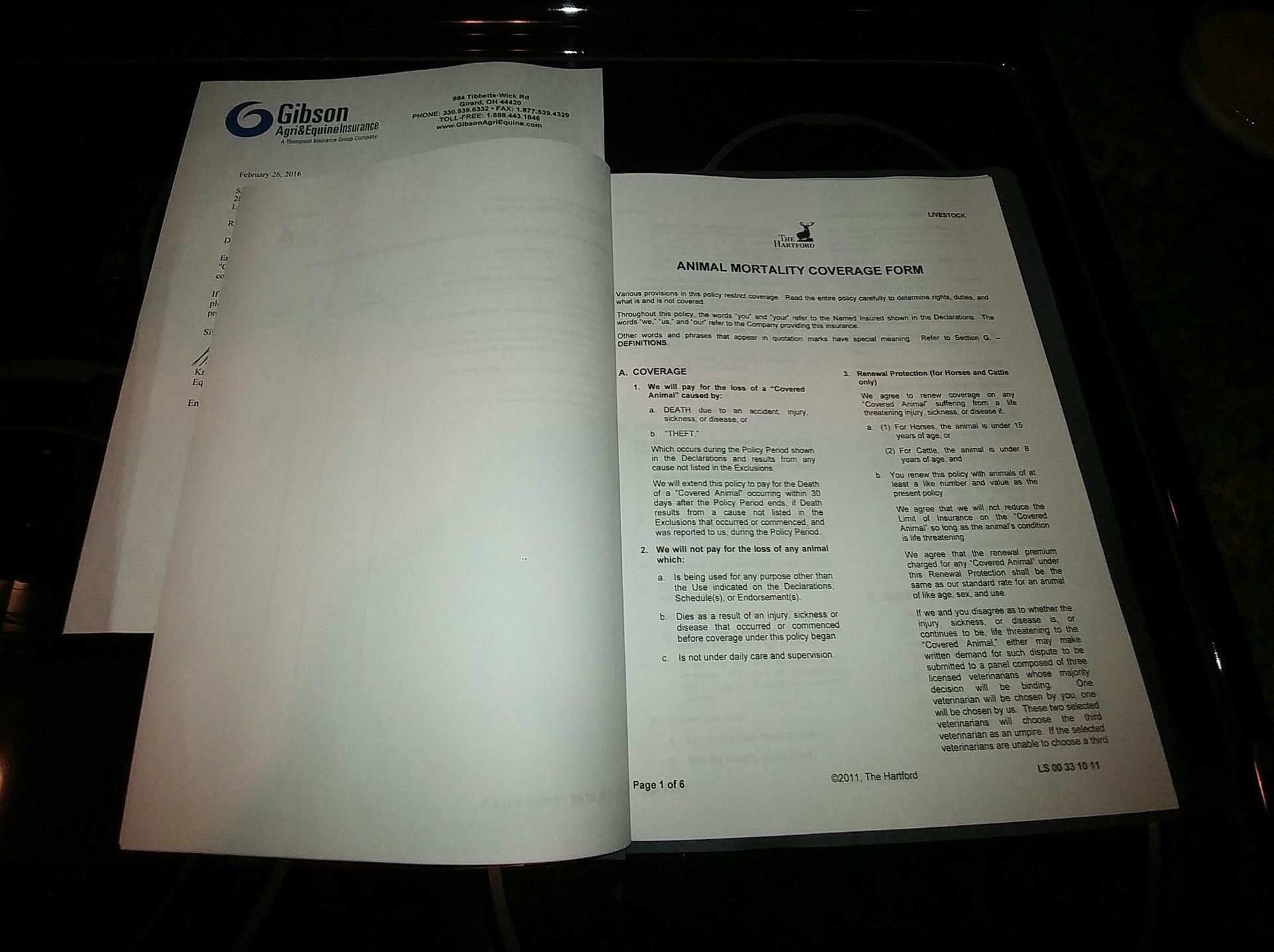
    The most popular equine insurance Kristin Detwiler sells in Girard, Ohio, is mortality and major medical. Detwiler, an Agribusiness and Equine Specialist with Gibson Agri&Equine Insurance, explains that “every policy is required to have mortality coverage and then anything else that is added is added as an "additional" endorsement.”

    So, she says, major medical, loss of use, surgical expense, extended renewal protection, accident, sickness and disease coverage, third party liability, and stallion infertility (among others) are all insurance options in addition to mortality coverage.

    Mortality coverage generally covers any cause of death, including colic or fatal injuries. A horse’s age will limit his mortality insurance; many insurance companies can insure horses that are 24 hours old up to about 17 years old. Detwiler notes that 15 years old is about when it becomes more costly to insure the horse and when medical packages are restricted.

    A horse can be insured later in life; but, for every year the horse ages after 15, the rate debits making it more expensive,” She explains. “Often, veterinarian examinations are required each year for older horses as well.

    Many factors are taken into account to determine a horse’s value; these can include age, sex, breed and discipline. A mortality policy can cover 100 percent of the horse’s value, but the premiums will be more expensive. While it can be very hard to objectively define what a horse is worth, it’s imperative to ensuring you have the adequate policy in place on your horse. 

    Major Medical


    Major medical insurance covers a lot of medical and surgical treatments that may be cost prohibitive for owners. This coverage can include things like medications, diagnostic tools, surgery and care after surgery.

    Major medical policies do not cover routine care like vaccines, teeth floating or sheath cleaning; many alternative treatments like acupuncture, chiropractic and massage are also not covered. Many policies also do not cover any cosmetic surgeries or surgeries on things that took place before the insurance policy took effect (think about things like birth defects).

    Detwiler notes that a pre-existing condition could limit insurance coverage. “If a horse has a history of lameness in a specific leg or a history of colic, the company is typically going to exclude coverage for that condition The horse can still be insured for coverage for other conditions, but that specific condition would be excluded. For example: If a horse is diagnosed and treated for EPM in writing the policy, all claims related to EPM would not be covered. However, a colic claim or an unrelated injury or sickness could still be covered.”

    “Insurance is designed to cover more ‘catastrophic’ accidents and injuries,” she says. “Though each company is different, there is always a deductible [around $300] for medical claims that are made. This helps to deter claims being made against routine procedures.”

    Colic Insurance Programs


    The American Association of Equine Practitioners estimates that 900,000 horses will colic in the United States each year. That number is staggering to think about! Gibson Agri&Equine Insurance is partnered with SmartPak to raise awareness of and education horse owners about colic. Detwiler explains that SmartPak has “a program in which if the horse is on SmartDigest Ultra [a SmartPak supplement] and is (strictly) following basic veterinary recommendations (up to date on shots, etc), SmartPak will cover up to $7,500 worth of veterinary expenses if the horse colics while on their supplement.”
    But this is all the policy will cover, she expounds. “Their program ONLY covers expenses related to colic, whereas if you also have an equine policy with major medical coverage, any other kind of accident, injury or sickness or disease would be covered as well. And, if the expenses exceed what is paid by SmartPak the equine insurance would kick in if the horse colics.” 

    The Application

    Be prepared to answer a lot of questions when it comes to insuring your equine. It will ask you everything from your name, address and phone number to details on where the horse is housed, who cares for him and what his intended use is. They will also ask his age, breed, sex and for a registration, tattoo or ID number. You will be asked to provide photos of your horse if it is not registered with an organization. You will also need to answer his date of birth and date of purchase. You will then be asked a series of question on the horse’s health and its history. These questions could include is he sound, has he colicked, has ever had joint injections or been nerved, does he have any conformational issues, and more.

    Additional questions may include who the primary veterinarian is, is the horse co-owned, is he leased and is he covered by any other insurance. 


    So, Who Really Needs Equine Insurance?

    “I would especially recommend equine insurnace for high-profile horses that were costly to purchase; this will protect the investment. And, these types of horses tend to be at greater risk as they are moving around--going to shows, races, in training, etc.. However, I would recommend it to any other horse owner as well. Even if the initial investment in the horse wasn't costly, the medical bills for any kind of accident or sickness can easily add up,” Detwiler says. “This is when it is beneficial to have the insurance to afford such expenses.” 

MSEDA News

Powered by Wild Apricot Membership Software